ضامن آهو
روایت محقق ژاپنی
در اتاقی کوچک و آرام در دانشگاه کیوتو، محققی ژاپنی مشغول بررسی دستهای از اسناد و گزارشهای پراکنده بود. او سالها به مطالعه رابطه میان «انسان و طبیعت» در فرهنگهای مختلف پرداخته بود و این بار مسیر تحقیقش او را به غرب آسیا کشانده بود.
مجموعهای از اسناد تاریخی و گزارشهای معاصر درباره منابع آب در ایران و غرب آسیا را مرتب میکرد. هدف او روشن بود: بررسی اینکه چگونه جوامع این منطقه، در طول سدهها، با کمآبی و تغییرات اقلیمی روبهرو شدهاند.
در یادداشتی که در دست محقق بود خاطره سپهبد قاسم سلیمانی بعنوان بالاترین مقام نظامی در میانه صدای تیراندازی و همهمه دشمن با فرمانده زیردست خود بود. او تماس گرفته و خواسته بود علوفه آهوهای اطراف پادگان را تامین کنند.
- گفت: با این برف آهوهایی که در کوه نزدیک پادگان مقر سپاه وجود دارد حتما برای پیدا کردن غذا پایین میآیند. همین امروز به اندازه کافی علوفه تهیه کن و در چند جا قرار بده که آنها از گرسنگی تلف نشوند.
محقق با کلید واژه «آهو» برای بررسی روایت های این چنینی در میان حافظه تاریخی ایرانیان، کاغذ دیگری بیرون کشید که تاریخ، آن را به بیش از هزار سال پیش میبرد؛ یک روایت درباره یکی از امامان شیعه بود. زمانی که علی بن موسیالرضا (ع) در خراسان میزیست. گزارش، ماجرای مشهوری را بازگو میکرد:
«گزارش اول »
ضامن آهو:
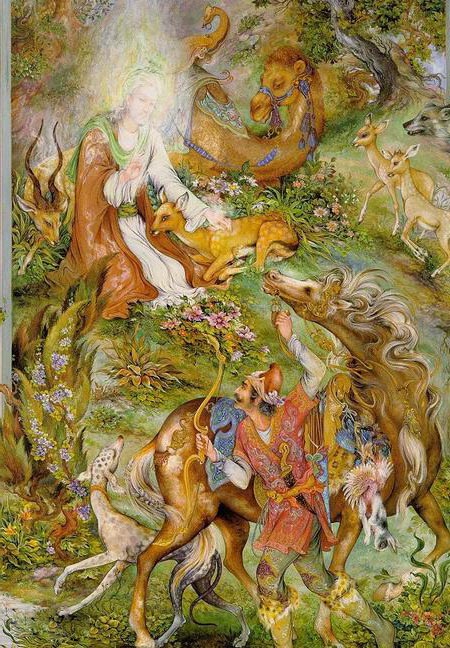
> صیادی در بیابانی قصد شکار آهویی میکند و آهو شکارچی را مسافت قابل توجهی به دنبال خود میدواند و عاقبت خود را به دامن حضرت علی بن موسی الرضا (ع) که اتفاقاً در آن حوالی حضور داشت می اندازد. صیاد که می رود آهو را بگیرد، با ممانعت حضرت رضا (ع) مواجه می شود، ولی صیاد چون آهو را صید و حق شرعی خود می دانست، در مطالبه و استرداد آهو پافشاری می کند.
امام حاضر می شود، مبلغی بیشتر از بهای آهو، به شکارچی بپردازد تا او آهو را آزاد کند. شکارچی نمی پذیرد و به عرض می رساند: الا و بالله، من همین آهو را که حق خودم است، می خواهم و نه غیر آن را …
و آن وقت آهو به زبان می آید و سخن گفتن آغاز می کند و به عرض امام می رساند که من دو بچه شیری دارم که گرسنه اند و چشم به راه اند که بروم شیرشان بدهم و سیرشان کنم. علت فرارم هم همین است و حالا شما ضمانت مرا نزد این شکارچی بفرمایید که اجازه دهد بروم و بچه هایم را شیر دهم و برگردم و تسلیم صیاد شوم.
امام رضا (ع) هم ضمانت آهو را نزد شکارچی کرد و خود را به صورت گروگان در اختیار وی قرار داد. آهو رفت و به سرعت بازگشت و خود را تسلیم شکارچی کرد. شکارچی که این وفای به عهد را می بیند، منقلب می شود و آن گاه متوجه می شود که گروگان او، علی بن موسی الرضا است.
محقق ژاپنی این ماجرا را نشانی از پیوند دیرین انسان ایرانی با طبیعت دید؛ محقق در حاشیه این گزارش نوشت :
در واقع، آهو (Gazella subgutturosa) که در ایران به نام "آهو" یا "غزال ایرانی" شناخته میشود، بیشتر زیستگاهش دشتهای باز، تپهماهورها و استپهای خشک و نیمهخشک است؛ یعنی مناطقی که پوشش گیاهی علفی و درختچهای پراکنده دارند.
بیابان (مثل کویر مرکزی با شن و نمکزار) برای آهو مناسب نیستند چون پوشش گیاهی کافی برای چرا ندارند.
اما بیابان به معنای عام (زمینهای باز، خشک و بدون جنگل) گاهی در متون قدیمی یا دینی به کار میرفته و منظور همان دشتها و استپها بوده.
پس وقتی در روایت گفته میشود "صیادی در بیابان قصد شکار آهویی کرد"، منظور بیشتر دشتهای باز و سبز خراسان است.
او ورقهای دیگر را به ترتیب زمان مرتب کرد و به دورهای نزدیکتر رسید؛ روایتهایی از زندگی عشایر ایران. در یادداشتها، نام جهانگیرخان قشقایی به چشم میخورد؛ شاهزاده ای از ایل قشقایی که در حاشیهی رود سمیرم می زیست.
«گزارش دوم»
گزارش دوم: جهانگیرخان قشقایی و طبیعت ایل
سال: حدود ۱۳۰۰ هجری شمسی
در دل فلات ایران، جایی که رود سمیرم آرام از میان دشتها و کوههای سبز میگذرد، جهانگیرخان قشقایی به دنیا آمد. او از کودکی میان چراگاهها و رودخانهها بزرگ شد؛ جایی که زندگی ایل قشقایی با زمین و آب و گیاهان تنیده بود.
روزی، هنگامی که جهانگیرخان هنوز نوجوان بود، ایل برای کوچ به مراتع بلند کوهستان آماده میشد. او به کنار رود رفت و دید که جریان آب چقدر به زندگی مردم وابسته است؛ ماهیها میپلکیدند، گاوها و گوسفندان برای نوشیدن آب صف کشیده بودند و پوشش گیاهی اطراف رودخانه، خاک را تثبیت کرده بود. او فهمید که اگر رودخانهها خشک شوند یا چراگاهها آسیب ببینند، زندگی ایل نابود خواهد شد.
جهانگیرخان در حدود ۴۰ سالگی، پس از دیدن مدرسه صدر اصفهان و تأثیر معنوی آن، تصمیم گرفت زندگی عشایری را رها کرده و به تحصیل علم بپردازد. او در اصفهان حجرهای گرفت و به تدریس و تربیت شاگردانی چون حاج آقا رحیم ارباب، سید حسین طباطبائی بروجردی، سید حسن مدرس و میرزا محمدحسین نائینی پرداخت. با این حال، او تا پایان عمر لباس عشایری را بر تن داشت و لباس مرسوم عالمان را نپوشید.
محقق در اینجا دریافت که طبیعت در زندگی عشایر یک عضو اصلی حیات آنها بوده است. محیط رودخانهها، چراگاهها و کوهها، محیط زندگی عادی مردم بود و حتی وقتی برای تحصیل از ایل رفت هم در شهر رود از کنار محل تحصیل عبور می کرد.
یادداشت محقق:
برای مطالعهی تاریخ آب در غرب آسیا، زندگی عشایر ایران نمونهای برجسته است. سامانه کوچنشینی آنها بر مبنای دسترسی به رودخانهها، چشمهها و چراگاهها شکل گرفته بود. چادرهای عشایر در امتداد مسیر آب برپا میشد و هر تغییر در میزان بارش، جابهجایی جمعیت را رقم میزد. زندگی جهانگیرخان قشقایی در چنین بستری نشان میدهد که حتی تحولات اجتماعی و فرهنگی، ریشه در مناسبات اکولوژیکی داشته است.
اما بخش پایانی دسته اسناد، او را به دوران معاصر رساند؛
گزارش سوم :
سال: حدود ۱۳۹۰ تا ۱۴۰۰ هجری شمسی
«گزارش سوم»
در سالهای اخیر تغییر اقلیم و شرایط آب و هوایی موجب تغییر نوع بارش از برف به باران شده است و تغییر نوع بارشها در مناطق کوهستانی، استان نیز جزو این مناطق است، مشهودتر است.
بارش بهصورت برف در ارتفاعات موجب میشود تا بر اثر ذوب تدریجی، آب حاصل از آن با شدت کمتر در زمین جاری شود. جاری شدن آب با شدت کمتر در نتیجه ذوب برف، موجب نفوذ تدریجی آب در زمین شده و تغذیه سفرههای آب زیرزمینی را در پی دارد.
اما وقوع بارندگیها بهصورت رگباری که طی سالهای اخیر بیشتر مشاهده میشود، باعث میشود آبهای جاریشده در زمین سرعت بیشتری به خود بگیرد و در مدتزمان اندکی از دسترس خارج شده و در تغذیهی سفرههای آب زیرزمینی تأثیر کمتری داشته باشد.
از همینرو، معاونت آبخیزداری ادارهکل منابعطبیعی استان طی سالهای اخیر در راستای کنترل آبهای جاری ناشی از بارشهای رگباری و شدید، اقدامات قابل توجهی انجام داده است. انجام عملیات مختلف از جمله آبخوانداری و تغذیه سفرههای زیرزمینی در بلندمدت باعث پرآب شدن قنوات و چشمهها خواهد شد و در منطقه ذاکر که آب شرق شهر زنجان از چاههای این محل تأمین میشود، شاهد اجرای طرحهای آبخوانداری هستیم.
با احداث حوضچهها و لایروبی آنها، حجم ذخیره آب افزایش یافته و حدود ۴ میلیون مترمکعب آب به سیستم تزریق خواهد شد. برای اجرای طرحهای آبخوانداری ۵ میلیارد تومان اعتبار اختصاص یافته است.
این بار گزارشها دقیقتر، آمارها کاملتر و روایتها جامعتر بودند. در اسناد آمده بود: «آهنگ کوثری پدر آبخوانداری ایران است». او طرحهایی برای ذخیره آب باران، لایروبی حوضچهها و تغذیه سفرههای زیرزمینی طراحی کرد که بعدها در بسیاری از استانهای کوهستانی کشور اجرا شد. محقق ژاپنی با دقت، نمودارها و نقشههای موجود را بررسی کرد نوشت:
کار کوثری یک اقدام فنی کاملا مناسب برای حفظ بارش ها و شبیه هنر های دیگر ایرانیان در حفظ آب بود، او با دانش علمی و نگاهی بومی، ضامن بقای سفرههای آب زیرزمینی شد. شبیه قنات و مسیر آب شهر پرسپولیس.
و بدنبال شهر پرسپولیس در میان اسنادش رفت.
یادداشت محقق:
اینجا دیگر با زبان علم و مدیریت منابع روبهرو هستیم. مسئله صلی، تغییر رژیم بارش در غرب آسیاست: کاهش برفهای کوهستانی و افزایش بارانهای سیلابی. این تغییر، ذخیره طبیعی آب را که قرنها ضامن حیات در منطقه بود، مختل کرده است.
در این میان، آهنگ کوثری بهعنوان بنیانگذار آبخوانداری ایران، نقش کلیدی داشت. او با طراحی حوضچهها و سازههای پخش سیلاب، روشی برای تغذیه مصنوعی سفرههای زیرزمینی ابداع کرد. این کار، معادل نوعی «ذخیرهسازی طبیعی» آب است؛ روشی که اکنون در بسیاری از کشورهای خشک جهان مورد توجه قرار گرفته است.
یادداشتی از آهنگ کوثری توجه او را به خود جلب کرد:
«آبخوانداری، آبخیزداریِ زیر و روی زمینی، به آبرفت درشتدانه و سیل نیازمند است. آبیاری سیلابی تنها در زمینهایی کمشیب میسر است. برای هر مکان، باید با توجه به شرایط آن برنامهریزی کرد؛ ساختن سد آخرین گزینه است. توجه داشته باشیم که وقتی با سیاستهای بومنشناسانه، شهرهای خود را بزرگ میکنیم (کشاورزان و عشایر را به سوی کلانشهرها سوق میدهیم)، باید برایشان لوازم رفاهی را تهیه کنیم. میخواهیم شقالقمر کنیم: آب دریای عمان را به یزد، دریای خزر را به سمنان و خلیج فارس را به گلگهر سیرجان و شیراز بیاوریم. »
محقق ژاپنی دفترچهاش را بست و در یادداشت پایانی نوشت: این طرح هنوز در حال توسعه است. «از روایتهای کهن دربارهی زیست آهو در بیابان، تا زندگی عشایر در حاشیه رودها، تا طرحهای مدرن آبخوانداری، یک خط پیوسته در تاریخ ایران و غرب آسیا دیده میشود: زندگی در این سرزمین، همواره حول محور آب و چگونگی مدیریت آن شکل گرفته است.
در اینجا، آب فقط منبع طبیعی نیست؛ بلکه نیرویی تعیینکننده در سازمان اجتماعی، کوچها، کشاورزی و حتی شکلگیری دانشهای بومی و مدرن است.»
_____________________
Narration of a Japanese researcher
In a small, quiet room at Kyoto University, a Japanese researcher was poring over a pile of scattered documents and reports. He had spent years studying the relationship between "humans and nature" in different cultures, and this time his research path had taken him to West Asia.
He was sorting through a collection of historical documents and contemporary reports on water resources in Iran and West Asia. His goal was clear: to examine how societies in this region have faced water scarcity and climate change over the centuries.
In a note in the researcher's hand, Lieutenant General Qassem Soleimani, the highest military official, was with his subordinate commander amidst the sound of gunfire and the roar of the enemy. He had called and asked to provide fodder for the deer around the barracks.
- He said: "With this snow, the deer that are on the mountain near the IRGC headquarters barracks will definitely come down to find food." Prepare enough fodder today and place it in several places so that they do not die of hunger.
The researcher, using the keyword "deer" to examine such narratives among the historical memory of the Iranians, pulled out another paper that history takes back more than a thousand years; it was a narrative about one of the Shiite Imams. When Ali ibn Musa al-Reza (a.s.) lived in Khorasan. The report recounted a famous story:
"First Report"
The Guarantee of the Deer:
> A hunter in the desert intends to hunt a deer and the deer chases the hunter for a considerable distance and eventually throws itself into the lap of Imam Ali ibn Musa al-Reza (a.s.), who happened to be present in the vicinity. The hunter, who goes to catch the deer, is faced with the prohibition of Imam Reza (a.s.), but the hunter insists on demanding and returning the deer, since he considered the deer to be his hunting and religious right.
The Imam is willing to pay the hunter a sum greater than the price of the deer so that he will release the deer. The hunter does not accept and says: By God, I want this deer that is my right and nothing else…
And then the deer speaks and starts talking and tells the Imam that I have two lion cubs that are hungry and are waiting for me to go and suckle them and feed them. This is the reason for my escape and now you should give me a guarantee to this hunter to allow me to go and suckle my cubs and return and surrender to the hunter.
Imam Reza (AS) also gave the deer guarantee to the hunter and gave himself to him as a hostage. The deer went and quickly returned and surrendered itself to the hunter. The hunter, seeing this fulfillment of the promise, is shocked and then realizes that his hostage is Ali ibn Musa al-Rida.
The Japanese researcher saw this incident as a sign of the ancient connection between Iranian man and nature; the researcher wrote in the margin of this report:
In fact, the gazelle (Gazella subgutturosa), known in Iran as "deer" or "Iranian gazelle", is mostly found in open plains, hilly areas, and dry and semi-arid steppes; that is, areas with scattered herbaceous and shrub vegetation.
Deserts (such as the central desert with sand and salt flats) are not suitable for deer because they do not have sufficient vegetation for grazing.
However, desert in a general sense (open, dry, forestless lands) was sometimes used in ancient or religious texts, and it meant the same plains and steppes.
So when the narrative says "a hunter in the desert intended to hunt a deer," it mostly refers to the open and green plains of Khorasan.
He arranged the other sheets in chronological order and arrived at a closer period; Narratives of the life of Iranian nomads. In the notes, the name of Jahangir Khan Qashqai appears; a prince of the Qashqai tribe who lived on the banks of the Semirom River.
"Second Report"
Second Report: Jahangir Khan Qashqai and the Nature of the Tribe
Year: Around 1921 AD
In the heart of the Iranian plateau, where the Semirom River flows gently through green plains and mountains, Jahangir Khan Qashqai was born. He grew up among pastures and rivers since childhood; where the life of the Qashqai tribe was intertwined with land, water, and plants.
One day, when Jahangir Khan was still a teenager, the tribe was preparing to migrate to the high mountain pastures. He went to the riverbank and saw how much the flow of water was dependent on the lives of the people; fish were swimming, cows and sheep were lining up to drink water, and the vegetation around the river had stabilized the soil. He understood that if the rivers dried up or the pastures were damaged, the life of the tribe would be destroyed.
At the age of about 40, after seeing the Sadr School of Isfahan and its spiritual influence, Jahangir Khan decided to abandon the nomadic life and study science. He took a room in Isfahan and taught and educated students such as Haj Agha Rahim Arbab, Seyyed Hossein Tabatabaei Borujerdi, Seyyed Hassan Modarres, and Mirza Mohammad Hossein Naeini. However, he wore nomadic clothing until the end of his life and did not wear the traditional dress of scholars.
Here, the researcher realized that nature was an essential part of the life of the nomads. The environment of rivers, pastures, and mountains was the normal living environment of the people, and even when he left the tribe to study, he would pass by the place of study in the city of Rud.
Researcher's note:
For the study of the history of water in West Asia, the life of the Iranian nomads is an outstanding example. Their nomadic system was based on access to rivers, springs, and pastures. Nomads' tents were set up along the watercourse, and any change in the amount of rainfall determined the movement of the population. Jahangir Khan Qashqai's life in such a context shows that even social and cultural developments had their roots in ecological relations.
But the final part of the collection of documents brought him to the contemporary era;
Third Report:
Year: Around 2011 to 2021 AD
"Third Report"
In recent years, climate change and weather conditions have caused a change in the type of precipitation from snow to rain, and
The change in the type of precipitation is more evident in mountainous areas, the province is also one of these areas.
Precipitation in the form of snow in the highlands causes the water to flow less intensively on the ground due to gradual melting. The flow of water with less intensity as a result of snow melting causes the water to gradually penetrate the ground and feeds the groundwater aquifers.
However, the occurrence of heavy rainfall, which has been observed more frequently in recent years, causes the water flowing on the ground to accelerate and become inaccessible in a short period of time and have less effect on feeding the groundwater aquifers.
Therefore, the Deputy of Watershed Management of the General Administration of Natural Resources of the province has taken significant measures in recent years to control the running water caused by heavy and heavy rainfall. Carrying out various operations, including aquifer management and feeding groundwater aquifers, will in the long term cause canals and springs to become full of water, and in the Zakir region, where water is supplied to the east of Zanjan from wells in this area, we are witnessing the implementation of aquifer management projects.
With the construction of ponds and their dredging, the volume of water storage will increase and about 4 million cubic meters of water will be injected into the system. 5 billion Tomans of credit has been allocated for the implementation of aquifer management projects.
This time, the reports were more accurate, the statistics more complete, and the narratives more comprehensive. The documents stated: “Ahang Kowsari is the father of Iranian aquifer management.” He designed projects for storing rainwater, dredging ponds, and feeding groundwater aquifers, which were later implemented in many mountainous provinces of the country. The Japanese researcher carefully examined the existing diagrams and maps and wrote:
Kowsari's work was a completely appropriate technical measure to preserve rainfall and similar to other Iranian arts in water conservation. With scientific knowledge and a native perspective, he ensured the survival of underground water tables. Similar to the qanat and water path of the city of Persepolis.
And he searched for the city of Persepolis among his documents.
Researcher's note:
Here we are again faced with the language of science and resource management. The main issue is the change in the precipitation regime in West Asia: the reduction of mountain snows and the increase in flood rains. This change has disrupted the natural water reserves that had guaranteed life in the region for centuries.
In the meantime, Ahang Kowsari, as the founder of Iranian aquifer management, played a key role. By designing ponds and flood-spreading structures, he invented a method for artificially feeding underground aquifers. This work is equivalent to a kind of "natural storage" of water; A method that is now being considered in many arid countries of the world.
A note from Ahang Kowsari caught his attention:
“Watershed management, both above and below ground, requires coarse-grained alluvium and flooding. Flood irrigation is only possible on gently sloping land. For each location, planning must be done according to its conditions; building a dam is the last option. Let us note that when we expand our cities with ecologically unsustainable policies (pushing farmers and nomads towards metropolises), we must provide them with amenities. We want to break the moon: bring water from the Sea of Oman to Yazd, the Caspian Sea to Semnan, and the Persian Gulf to Golgohar, Sirjan, and Shiraz.”
The Japanese researcher closed his notebook and wrote in a final note: This plan is still under development. “From ancient tales of the life of deer in the desert, to the life of nomads on the banks of rivers, to modern water management schemes, a continuous line can be seen in the history of Iran and West Asia: life in this land has always been shaped around water and how it is managed. Here, water is not just a natural resource; it is a determining force in social organization, nomadism, agriculture, and even the formation of indigenous and modern knowledge.”